If you've been watching the news lately, you've probably heard that inflation is moving in the wrong direction again. While that may sound concerning, it's important to understand what it actually

Dated: February 19 2026
Views: 26

If you saw headlines that talked about how “home sales fell sharply in January,” it probably raised an eyebrow – especially if you’re thinking about selling your house. But context matters.
Yes, in January, home sales declined. But that has more to do with seasonality and the weather than it does with any big drop off in demand.
Reports coming out of the National Association of Realtors (NAR) say the pace of home sales fell roughly 8.4% last month compared to the month before. And that’s true. But it isn’t necessarily cause for alarm.
Data show it’s normal for sales to dip in January. In the last 4 years, that pattern has held true all but once. And sure, the decline we saw this year was a steeper drop off than the norm (the yellow bars on the right), but that can be explained too. More on that in a moment.
The really important part you’re not going to get from the headlines is this: typically speaking, the pace of home sales picks back up in February as the spring market starts to take off. That’s shown in the green bars below.
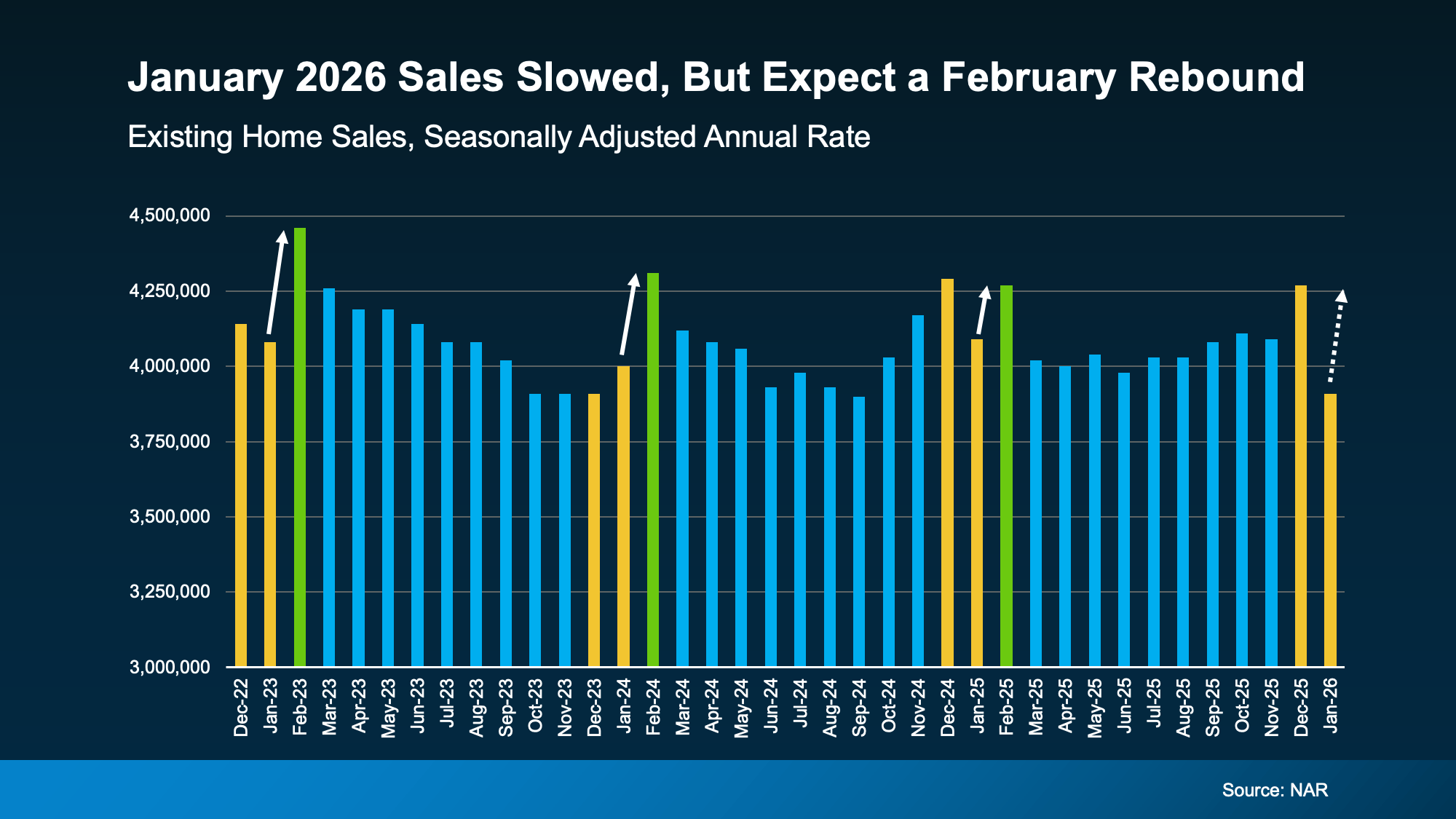 So even though the market slowed a bit momentarily, it should start to pick back up.
And just in case you’re wondering, why the bigger drop this year, especially with mortgage rates being lower than last year? Here’s your answer. As Realtor.com explains:
“Winter storm Fern, which dumped snow and ice across large swaths of the country, likely disrupted some closings, weighing on the data and making it difficult to pick out the housing market momentum trend from the weather noise.”
This January, 40 states were hit with widespread winter weather according to the National Weather Service. And in real estate, that slows down the momentum. Here’s why.
Existing home sales data tracks closed transactions, not new contracts. So, if inspections, appraisals, or final walk-throughs get delayed by storms, those deals often slide into the next month instead of falling apart – especially when buyers and sellers are still trying to move forward.
January’s missing sales are more likely “postponed” than “lost.” They haven’t disappeared. They’re just taking a little longer to close.
The rest of the data still points to a market that has traction heading into spring.
Affordability has improved for the 7th month in a row, and buyers are regaining negotiating power in many markets throughout the nation. So, this one monthly report doesn’t mean buyers aren’t buying. It just means, as weather warms up, activity should too.
Don’t confuse a weather-impacted month with a market losing steam. If anything, improving affordability is an indicator of more activity to come, not less.
If you have questions about what you’re hearing online or in the news, let’s chat. Because the truth is, a little context can give you back your peace of mind.

As a lifelong resident of Long Island’s South Shore, Dana possesses an intimate knowledge of the area’s charm and diversity. With over 22 years of real estate expertise, she pairs her deep....
If you've been watching the news lately, you've probably heard that inflation is moving in the wrong direction again. While that may sound concerning, it's important to understand what it actually
The Mid-Year Housing Market Update: Why Forecasts Changed in 2026If the Long Island housing market feels a little confusing right now, you're not imagining it.Many buyers entered 2026 expecting
Less House, More Home: Why Smaller Homes Are Paying Off for Today’s BuyersLess House, More Home: Why Smaller Homes Are Paying Off for Long Island BuyersIf you've been searching for a home on
You may be telling yourself you're going to wait to move. Maybe you're hoping mortgage rates will come down, prices will soften, or the market will feel a little less competitive.A lot of people
 OneKey® MLS required Copyright, Source of Data and Disclaimer for IDX display
Information Copyright 2026, OneKey® MLS. All Rights Reserved.
The source of the displayed data is either the property owner or public record provided by non-governmental third parties. It is believed to be reliable but not guaranteed. This information is provided exclusively for consumers' personal, non-commercial use.
The data relating to real estate for sale on this website comes in part from the
IDX Program of OneKey® MLS.
OneKey® MLS required Copyright, Source of Data and Disclaimer for IDX display
Information Copyright 2026, OneKey® MLS. All Rights Reserved.
The source of the displayed data is either the property owner or public record provided by non-governmental third parties. It is believed to be reliable but not guaranteed. This information is provided exclusively for consumers' personal, non-commercial use.
The data relating to real estate for sale on this website comes in part from the
IDX Program of OneKey® MLS.
33. Required DMCA Notice
The Digital Millennium Copyright Act of 1998, 17 U.S.C. §512, the DMCA, provides recourse for copyright owners who believe that material appearing on the Internet infringes their rights under U.S. copyright law. If you believe in good faith that any content or material made available in connection with our website or services infringes your copyright, you (or your agent) may send us a notice requesting that the content or material be removed, or access to it blocked. Notices must be sent in writing by email to DMCAnotice@MLSGrid.com. The DMCA requires that your notice of alleged copyright infringement include the following information: (1) description of the copyrighted work that is the subject of claimed infringement; (2) description of the alleged infringing content and information sufficient to permit us to locate the content; (3) contact information for you, including your address, telephone number and email address; (4) a statement by you that you have a good faith belief that the content in the manner complained of is not authorized by the copyright owner, or its agent, or by the operation of any law; (5) a statement by you, signed under penalty of perjury, that the information in the notification is accurate and that you have the authority to enforce the copyrights that are claimed to be infringed; and (6) a physical or electronic signature of the copyright owner or a person authorized to act on the copyright owner\'s behalf. Failure to include all of the above information may result in the delay of the processing of your complaint.
Show More...