If you've been watching the news lately, you've probably heard that inflation is moving in the wrong direction again. While that may sound concerning, it's important to understand what it actually

Dated: February 27 2026
Views: 82

Renting can feel like the easier choice right now. There’s no big down payment. No dealing with surprise repairs. And no long-term commitment.
But then your rent goes up again. And again. And suddenly the thing that seemed flexible starts looking… expensive, especially considering you’re not building any equity. And once that happens, it’s easy to feel a little trapped in the cycle.
That’s because there’s so much chatter today about how buying a home isn’t affordable. But the truth is, the math may work out better than you'd expect based on what’s changed recently.
In a lot of places today, owning a home actually costs less each month than renting a 3-bedroom home. And recent data from ATTOM shows that’s true in nearly 58% of counties across the U.S. (see chart below).
And that's after you factor in things like insurance and typical maintenance costs.
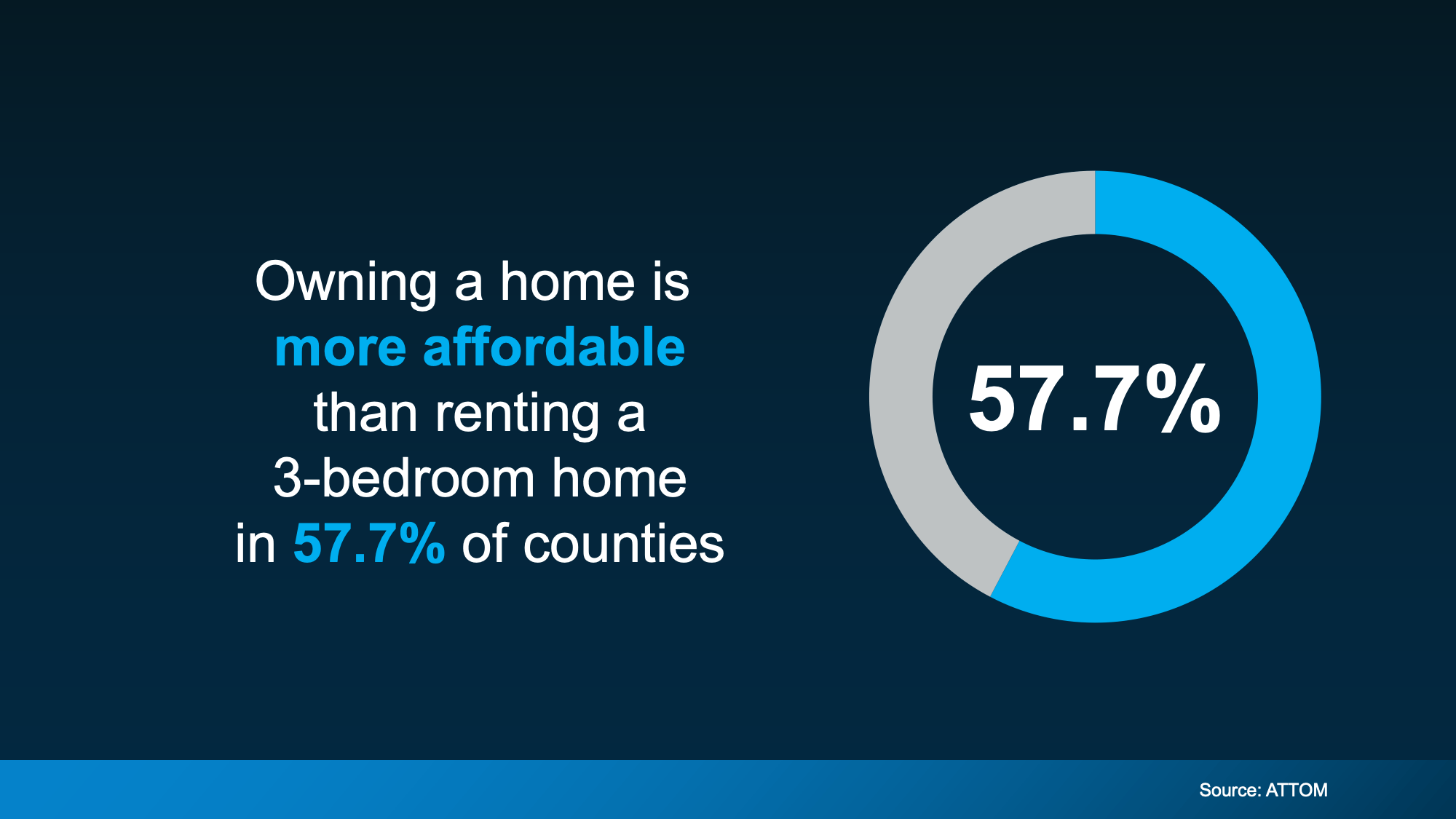 In other words, even though it may feel like a bit of a shock, the numbers show rent often stretches monthly budgets more than owning does. That’s thanks to slower home price growth, more homes for sale, and monthly mortgage payments starting to ease as rates come down.
Now, even though nationally the balance has shifted, that doesn’t mean buying is more affordable in every market or for every renter.
While buying is more affordable than renting in nearly 58% of counties nationwide, that share looks different depending on your region (see graph below):
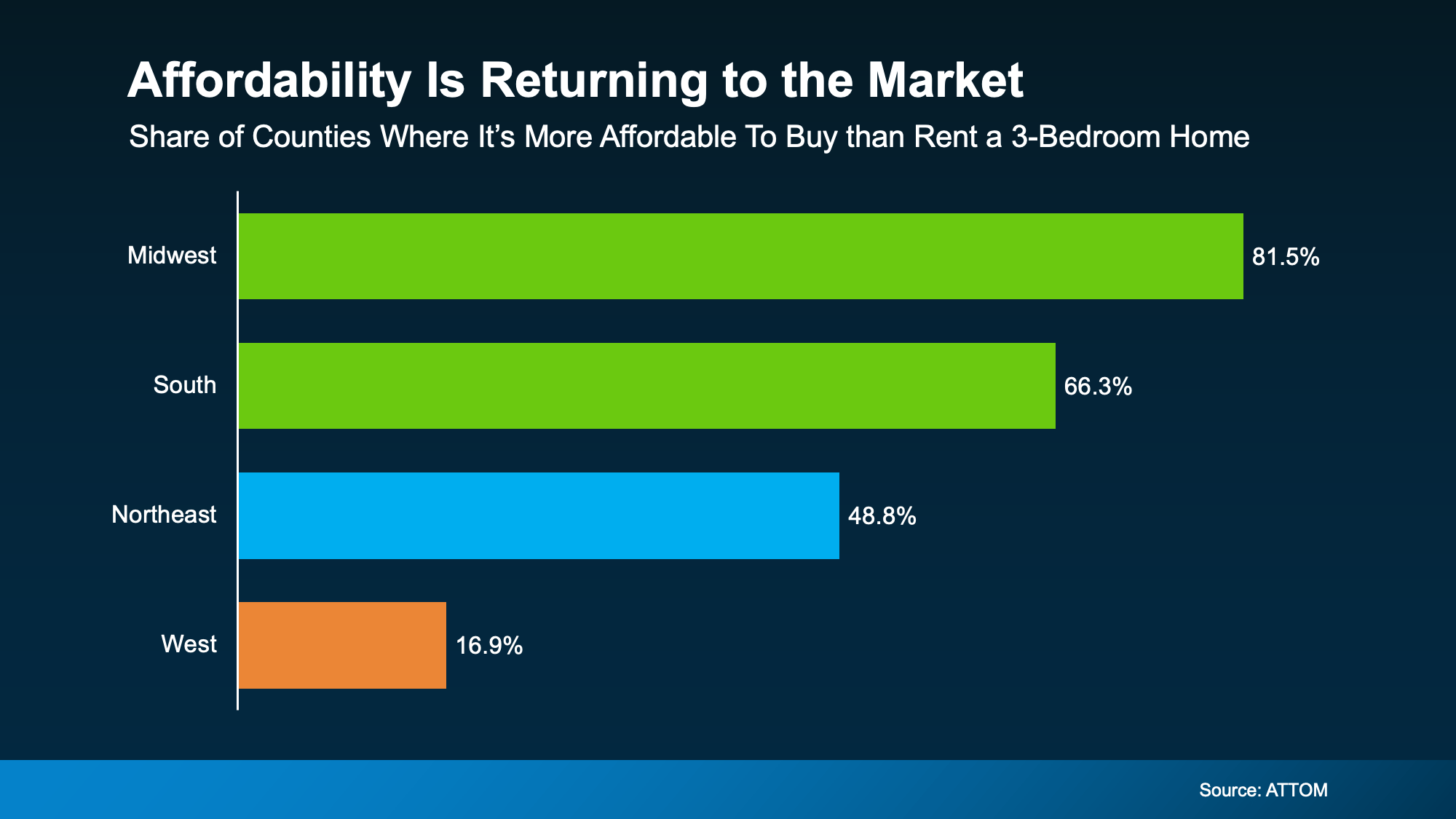
The biggest improvement is happening in the Midwest and South. But if you’re living in the West, things could still feel tight.
The takeaway? How affordable buying is really depends on where you live. And the only way to know how this plays out where you live is to look at the numbers locally.
Maybe you’re nodding along so far but thinking, “Okay, but I still can’t afford the upfront costs.” If that’s your reaction, you’re not the only one.
For many renters, the biggest hurdle isn’t the monthly payment alone. It’s the down payment, too.
But you’re not out of options. Here’s the part most people don’t hear enough about: there are thousands of down payment assistance programs available across the country, and many buyers qualify without realizing it.
And the average benefit? Roughly $18,000.
That kind of support can help cover part of your down payment or closing costs, which means you may not need to save nearly as much as you think to get started.
When you combine that with monthly payments that may work better than expected, especially as rates continue to ease and prices cool, buying may feel far more realistic than it looks at first glance.
The point isn’t that everyone should rush out and buy a home tomorrow.
It’s that renting isn’t always the more affordable option people assume it is – and buying may be more realistic than it feels once you look at the full picture.
If you’re renting and feeling stuck in the “someday” loop, it might be worth a simple conversation. Just a chance to see what’s possible and whether it makes sense for you.

As a lifelong resident of Long Island’s South Shore, Dana possesses an intimate knowledge of the area’s charm and diversity. With over 22 years of real estate expertise, she pairs her deep....
If you've been watching the news lately, you've probably heard that inflation is moving in the wrong direction again. While that may sound concerning, it's important to understand what it actually
The Mid-Year Housing Market Update: Why Forecasts Changed in 2026If the Long Island housing market feels a little confusing right now, you're not imagining it.Many buyers entered 2026 expecting
Less House, More Home: Why Smaller Homes Are Paying Off for Today’s BuyersLess House, More Home: Why Smaller Homes Are Paying Off for Long Island BuyersIf you've been searching for a home on
You may be telling yourself you're going to wait to move. Maybe you're hoping mortgage rates will come down, prices will soften, or the market will feel a little less competitive.A lot of people
 OneKey® MLS required Copyright, Source of Data and Disclaimer for IDX display
Information Copyright 2026, OneKey® MLS. All Rights Reserved.
The source of the displayed data is either the property owner or public record provided by non-governmental third parties. It is believed to be reliable but not guaranteed. This information is provided exclusively for consumers' personal, non-commercial use.
The data relating to real estate for sale on this website comes in part from the
IDX Program of OneKey® MLS.
OneKey® MLS required Copyright, Source of Data and Disclaimer for IDX display
Information Copyright 2026, OneKey® MLS. All Rights Reserved.
The source of the displayed data is either the property owner or public record provided by non-governmental third parties. It is believed to be reliable but not guaranteed. This information is provided exclusively for consumers' personal, non-commercial use.
The data relating to real estate for sale on this website comes in part from the
IDX Program of OneKey® MLS.
33. Required DMCA Notice
The Digital Millennium Copyright Act of 1998, 17 U.S.C. §512, the DMCA, provides recourse for copyright owners who believe that material appearing on the Internet infringes their rights under U.S. copyright law. If you believe in good faith that any content or material made available in connection with our website or services infringes your copyright, you (or your agent) may send us a notice requesting that the content or material be removed, or access to it blocked. Notices must be sent in writing by email to DMCAnotice@MLSGrid.com. The DMCA requires that your notice of alleged copyright infringement include the following information: (1) description of the copyrighted work that is the subject of claimed infringement; (2) description of the alleged infringing content and information sufficient to permit us to locate the content; (3) contact information for you, including your address, telephone number and email address; (4) a statement by you that you have a good faith belief that the content in the manner complained of is not authorized by the copyright owner, or its agent, or by the operation of any law; (5) a statement by you, signed under penalty of perjury, that the information in the notification is accurate and that you have the authority to enforce the copyrights that are claimed to be infringed; and (6) a physical or electronic signature of the copyright owner or a person authorized to act on the copyright owner\'s behalf. Failure to include all of the above information may result in the delay of the processing of your complaint.
Show More...