If you've been watching the news lately, you've probably heard that inflation is moving in the wrong direction again. While that may sound concerning, it's important to understand what it actually

Dated: January 19 2026
Views: 46

It’s hard to scroll online lately without seeing some version of this claim:
“Big investors are buying up all the homes.”
And honestly, if you’re a homebuyer who’s lost out on a few offers, that idea probably sounds believable. When homes are expensive and competition is tight, it’s easy to assume giant companies are scooping everything up behind the scenes.
But here’s the thing: what people assume is happening and what the data actually shows aren’t always the same.
Let’s look at what’s really happening with large institutional investors in today’s housing market – because the numbers tell a much different story than the headlines.
Let’s start with the most important stat. According to John Burns Research & Consulting (JBREC), large institutional investors – those that own 100 or more homes – made up just 1.2% of all home purchases in Q3 of 2025 (see graph below):
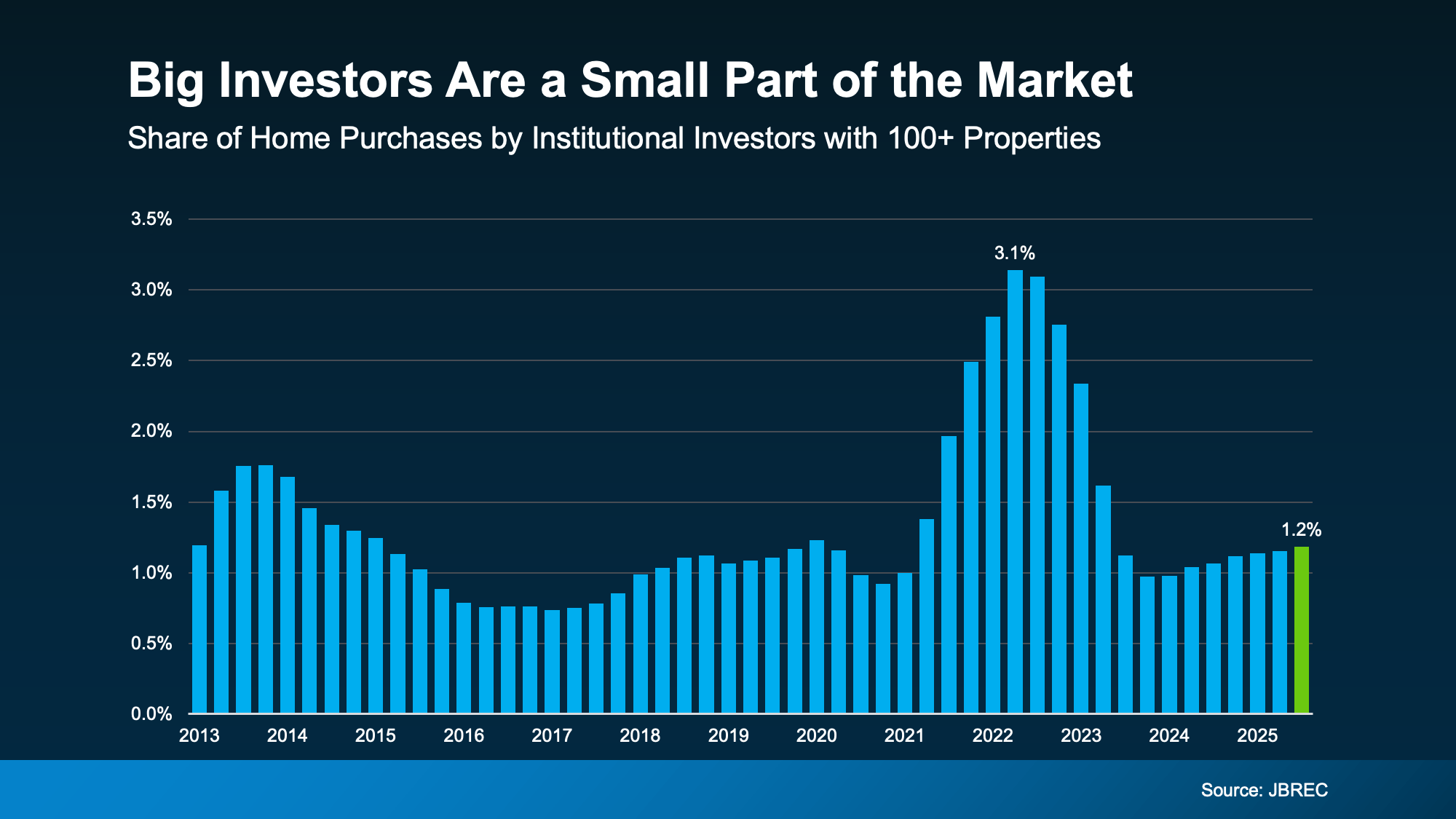 That’s it. Out of every 100 homes sold, only about 1 went to a large institutional investor.
And here’s an important point that often gets missed: that level of investor activity is very much in line with historical norms. It’s not unusually high, and it’s actually well below the recent peak of 3.1% back in 2022 – which itself was still a small share of the overall market.
So, while it can feel like big investors are everywhere, nationally, they’re a very small part of overall home sales.
There are two main reasons this topic gets so much attention:
Yes, big investors exist. Yes, they buy homes. But nationally, they’re responsible for a very small share of total purchases – far smaller than most people assume.
The bigger challenges around affordability have much more to do with supply, demand, and years of underbuilding than with large institutions competing against everyday buyers.
That’s why it’s so important to separate noise from reality, especially if you’re trying to decide if now is the right time to move.
If you want to talk through what investor activity actually looks like in our local market, and how it impacts your options (or doesn’t), let’s connect.
Sometimes a little context makes all the difference.

As a lifelong resident of Long Island’s South Shore, Dana possesses an intimate knowledge of the area’s charm and diversity. With over 22 years of real estate expertise, she pairs her deep....
If you've been watching the news lately, you've probably heard that inflation is moving in the wrong direction again. While that may sound concerning, it's important to understand what it actually
The Mid-Year Housing Market Update: Why Forecasts Changed in 2026If the Long Island housing market feels a little confusing right now, you're not imagining it.Many buyers entered 2026 expecting
Less House, More Home: Why Smaller Homes Are Paying Off for Today’s BuyersLess House, More Home: Why Smaller Homes Are Paying Off for Long Island BuyersIf you've been searching for a home on
You may be telling yourself you're going to wait to move. Maybe you're hoping mortgage rates will come down, prices will soften, or the market will feel a little less competitive.A lot of people
 OneKey® MLS required Copyright, Source of Data and Disclaimer for IDX display
Information Copyright 2026, OneKey® MLS. All Rights Reserved.
The source of the displayed data is either the property owner or public record provided by non-governmental third parties. It is believed to be reliable but not guaranteed. This information is provided exclusively for consumers' personal, non-commercial use.
The data relating to real estate for sale on this website comes in part from the
IDX Program of OneKey® MLS.
OneKey® MLS required Copyright, Source of Data and Disclaimer for IDX display
Information Copyright 2026, OneKey® MLS. All Rights Reserved.
The source of the displayed data is either the property owner or public record provided by non-governmental third parties. It is believed to be reliable but not guaranteed. This information is provided exclusively for consumers' personal, non-commercial use.
The data relating to real estate for sale on this website comes in part from the
IDX Program of OneKey® MLS.
33. Required DMCA Notice
The Digital Millennium Copyright Act of 1998, 17 U.S.C. §512, the DMCA, provides recourse for copyright owners who believe that material appearing on the Internet infringes their rights under U.S. copyright law. If you believe in good faith that any content or material made available in connection with our website or services infringes your copyright, you (or your agent) may send us a notice requesting that the content or material be removed, or access to it blocked. Notices must be sent in writing by email to DMCAnotice@MLSGrid.com. The DMCA requires that your notice of alleged copyright infringement include the following information: (1) description of the copyrighted work that is the subject of claimed infringement; (2) description of the alleged infringing content and information sufficient to permit us to locate the content; (3) contact information for you, including your address, telephone number and email address; (4) a statement by you that you have a good faith belief that the content in the manner complained of is not authorized by the copyright owner, or its agent, or by the operation of any law; (5) a statement by you, signed under penalty of perjury, that the information in the notification is accurate and that you have the authority to enforce the copyrights that are claimed to be infringed; and (6) a physical or electronic signature of the copyright owner or a person authorized to act on the copyright owner\'s behalf. Failure to include all of the above information may result in the delay of the processing of your complaint.
Show More...